

Dr Colum Nolan
Senior Consultant Spine & Neurosurgeon
MB, BCh, BAO, LRCPSI, MRCSI, FRCSI (Neurosurgery)
An MRI report mentioning a disc tear or herniated disc can raise questions about what has actually happened to your spine. Both terms describe changes to a spinal disc, but they refer to different structural problems. If your report mentions an annular tear or annular fissure, you may also wonder whether this is another name for a herniated disc or a separate condition altogether.
The distinction matters because the type of disc change, its location and whether nearby nerves are affected can influence the symptoms you experience and the treatment recommended. However, an MRI finding does not always explain the pain you are experiencing, and neither diagnosis automatically means surgery is necessary.
Understanding Disc Tears and Herniated Discs
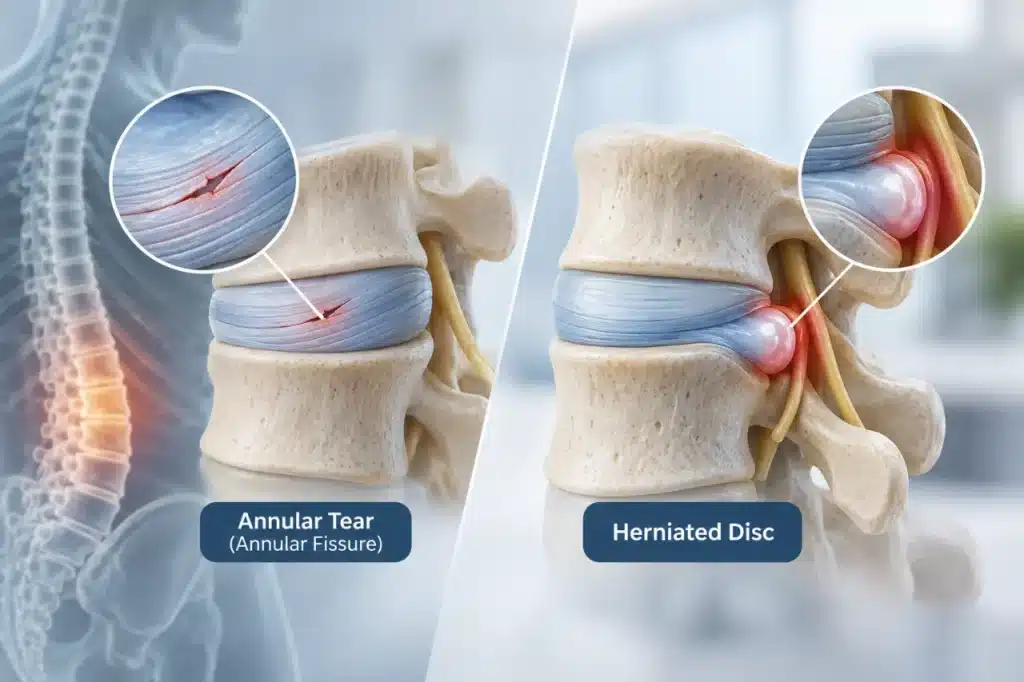
Spinal discs sit between the vertebrae and help absorb pressure during movement. Each disc has a tough outer ring called the annulus fibrosus and a softer, gel-like centre known as the nucleus pulposus. A disc tear and a herniated disc involve changes to these structures, but the nature of the damage differs.
Annular Tear
An annular tear, also called an annular fissure, is a separation or split in the fibres of the disc’s outer ring. These fissures may develop through age-related degeneration or mechanical stress and do not necessarily involve the inner disc material moving out of place.
Some annular tears cause no symptoms, while others may be associated with localised back pain due to irritation of nerve endings within the outer disc.
Herniated Disc
A herniated disc occurs when disc material extends beyond its normal boundaries. Depending on the type of herniation, the displaced material may remain contained by the outer disc fibres or extend through a defect in them.
A herniated disc may cause pain if it irritates surrounding structures. If it affects a nerve root, pain, numbness or weakness may travel into the arm when the disc is in the neck or down the leg when it is in the lower back.
An annular fissure and disc herniation can also occur together, so finding one does not necessarily exclude the other.
Disc Tear vs Herniated Disc: Key Differences
The differences between an annular tear and a herniated disc become particularly relevant when considering pain patterns, possible nerve involvement and the significance of MRI findings.
| Feature | Annular Tear (Annular Fissure) | Herniated Disc |
| Structural change | A separation or fissure in the disc’s outer fibres. | Disc material extends beyond its normal boundaries. |
| Pain pattern | May cause localised back pain, although some tears are asymptomatic. | May cause back or neck pain, with symptoms sometimes extending into an arm or leg. |
| Nerve involvement | May cause local inflammation or irritation without direct nerve compression. | Displaced disc material may irritate or compress a nearby nerve root. |
| MRI findings | May appear as a high-intensity zone within the outer disc on certain MRI sequences. | May appear as a protrusion, extrusion or sequestration of disc material. |
| Treatment considerations | Often managed conservatively when symptomatic, with treatment directed towards pain and function. | Often managed conservatively initially, although significant nerve compression or neurological deficits may warrant further intervention. |
How Doctors Interpret Your MRI Findings
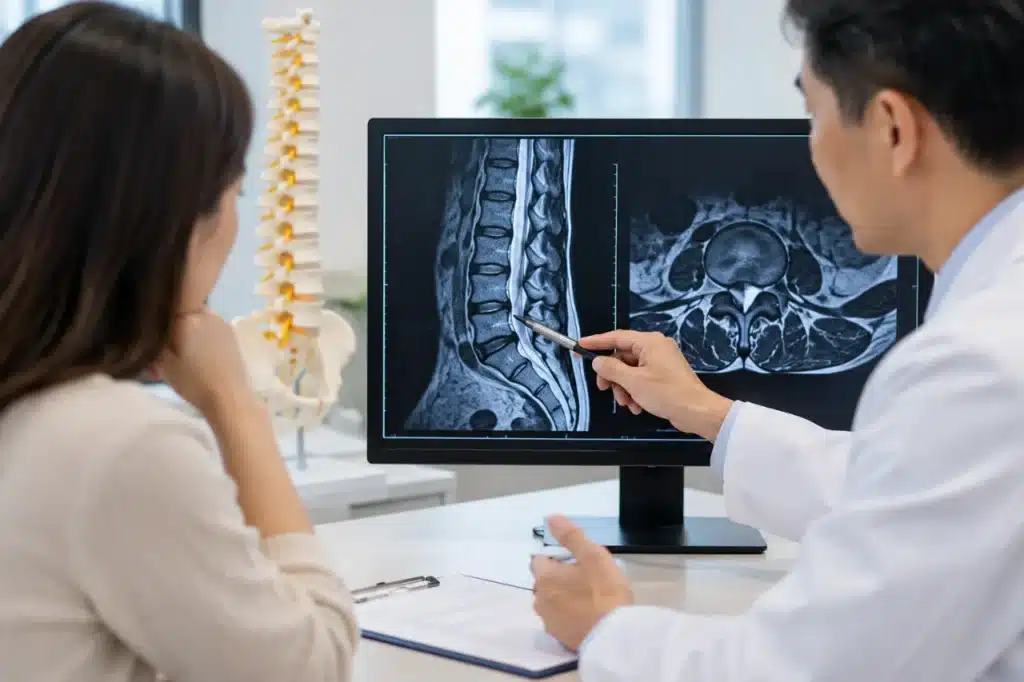
Annular fissures and disc herniations can appear on MRI scans even in people without symptoms. Their clinical significance therefore depends on whether the imaging findings correspond with the patient’s symptoms and examination results.
To determine whether an MRI finding is clinically significant, the assessment considers:
- Symptom history: Where the pain is felt, how it developed and whether it extends into an arm or leg.
- Physical examination: Spinal movement, muscle strength, sensation and reflexes may be assessed to identify signs of nerve involvement.
- Location of the disc abnormality: The affected spinal level and the position of the tear or herniation are compared with the patient’s symptoms and examination findings.
- Evidence of nerve compression: The MRI is reviewed for contact with or compression of nearby nerve structures, particularly when neurological symptoms are present.
For example, a lumbar disc herniation affecting a nerve root may help explain pain radiating down the leg, especially when the examination findings correspond with the affected nerve. An annular fissure without nerve compression may be considered a possible source of localised back pain, although its presence does not establish that it is responsible for the symptoms.
How Treatment Differs Between a Disc Tear and Herniated Disc
Both annular tears and herniated discs are commonly managed with non-surgical treatment initially. The main differences arise when symptoms persist or a herniated disc causes clinically significant nerve compression.
Treatment for an Annular Tear
When an annular tear is considered a likely source of back pain, treatment generally focuses on managing discomfort and improving spinal function. Most patients are initially offered non-surgical care, which may include:
- Physiotherapy: Exercises to improve spinal stability, strengthen supporting muscles and gradually restore movement.
- Activity modification: Adjusting movements or activities that aggravate pain while maintaining an appropriate level of physical activity.
- Medication: Suitable pain-relieving or anti-inflammatory medication may be prescribed to manage symptoms.
For persistent annular tear back pain, further evaluation may be needed to determine whether the fissure is responsible for the symptoms or whether other spinal conditions are contributing. Surgery is not routinely recommended for an isolated annular fissure.
Treatment for a Herniated Disc
Herniated disc treatment depends partly on whether displaced disc material is irritating or compressing a nearby nerve. Many patients improve with non-surgical care, but persistent nerve-related symptoms or neurological deficits may require additional intervention.
Treatment options for a slipped disc may include:
- Physiotherapy and activity modification: To support recovery, maintain mobility and reduce movements that aggravate symptoms.
- Medication: Pain-relieving or anti-inflammatory medication may help manage discomfort, depending on the patient’s condition.
- Epidural steroid injections: May be considered for selected patients with persistent nerve-related pain to help reduce inflammation and provide symptom relief.
- Surgical decompression: Procedures such as discectomy or microdiscectomy may be considered when nerve compression causes persistent disabling symptoms despite appropriate non-surgical treatment, or when significant neurological deficits are present.
The decision to proceed with surgery depends on the severity of symptoms, neurological findings and whether the imaging identifies a surgically treatable cause. New bladder or bowel dysfunction, numbness around the groin or rapidly worsening limb weakness require urgent medical assessment.
Getting the Right Care for Your Disc Condition
Finding an annular tear or herniated disc on your MRI can leave you uncertain about whether treatment is necessary and which options may be suitable. Persistent pain, changes in mobility or symptoms suggesting nerve involvement may warrant a closer review of how the imaging findings relate to your condition. At Oxford Spine & Neurosurgery Centre, Dr Colum Nolan evaluates spinal disc abnormalities alongside your symptoms and examination findings to help establish an appropriate course of care.
Depending on the findings, Dr Colum Nolan can explain whether continued non-surgical management is appropriate or whether further intervention should be considered, particularly if nerve compression is affecting your function.
Arrange a consultation to discuss your MRI findings and treatment options.
Frequently Asked Questions (FAQs) About Disc Tears and Herniated Discs
Can an annular tear heal on its own?
An annular tear may become less symptomatic over time, although the structural fissure can remain visible on imaging. Healing varies depending on the extent of disc degeneration and other individual factors. Improvement in pain does not necessarily mean the tear has completely closed, and a persistent MRI finding does not always indicate an ongoing problem.
Can an annular tear develop into a herniated disc?
An annular tear can weaken part of the disc’s outer ring and may be associated with a herniation if disc material becomes displaced. However, not every annular tear progresses to a herniated disc. The presence of a fissure alone cannot reliably predict whether a herniation will develop.
Can you exercise with an annular tear or herniated disc?
Many people can remain physically active with either condition, although exercises may need to be adjusted according to symptoms. Low-impact movement and guided strengthening may be appropriate during recovery. Activities that provoke significant pain or neurological symptoms should be reviewed with a healthcare professional before continuing.
Meet Our Doctor
Dr Colum Nolan
Senior Consultant Spine & Neurosurgeon
MB, BCh, BAO, LRCPSI, MRCSI, FRCSI (Neurosurgery)
Dr Colum Nolan is a senior consultant spine and neurosurgeon, as well as the Medical Director of Oxford Spine & Neurosurgery Centre. He undertook specialist neurosurgery training in Ireland and Australia, and later on completed a complex spine surgery fellowship at Addenbrooke’s Hospital in Cambridge, UK.
Dr Colum held key leadership roles including Director of the Spine and Spinal Disorders Programme at the National Neuroscience Institute (NNI), as well as the Head of Neurosurgery Service at Sengkang General Hospital.
With his depth of experience, Dr Colum is committed to guiding each patient towards the safest and most effective treatment for their needs.