
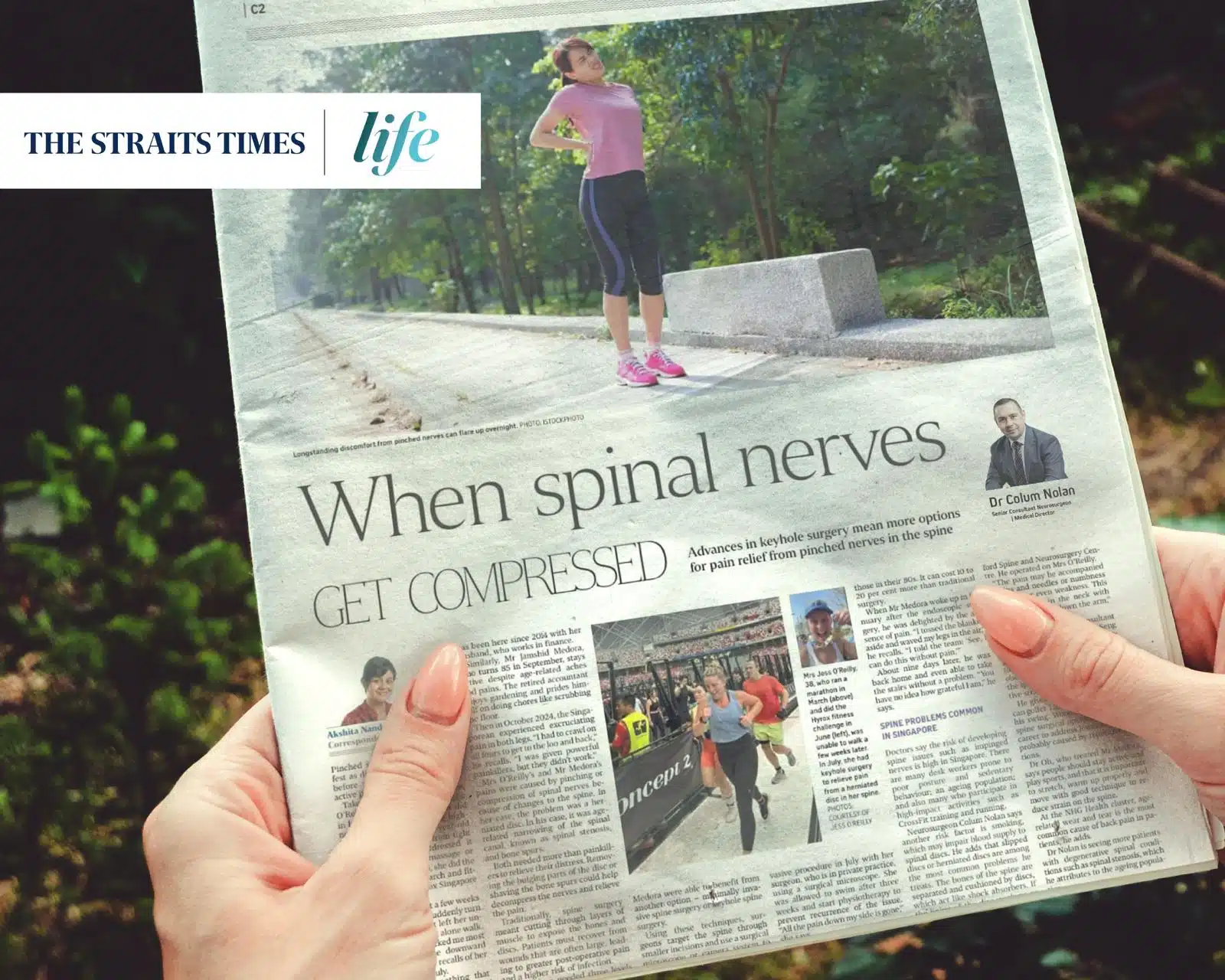
When The Straits Times recently featured the case of Ms Jessica O’Reilly, a patient under the care of Dr Colum Nolan, it highlighted how spinal nerve compression can disrupt even the most active lifestyles. For Dr Nolan, Senior Consultant Neurosurgeon and Medical Director at Oxford Spine and Neurosurgery Centre, such cases bring a sense of fulfilment — reminding him of the importance of advancing care that helps patients preserve mobility and independence.
“Every case reinforces why I do this work,” Dr Nolan shares. “It is fulfilling to see how minimally invasive techniques allow us to provide safer, gentler options that support patients in returning to their lives with dignity and confidence.”
Understanding Spinal Nerve Compression
Slipped or herniated discs are among the most common spinal conditions Dr Nolan treats. These occur when the disc lining weakens or tears, pressing on nearby nerves. Patients often present with sciatica — sharp pain radiating down the leg, sometimes accompanied by tingling, numbness, or weakness.
Other conditions such as spinal stenosis, where the spinal canal narrows with age, and osteoporosis-related compression fractures are also increasingly seen in Singapore’s ageing population.
When to Seek Specialist Care
Many people attempt physiotherapy, medication, or rest as their first step. Dr Nolan advises consulting a specialist when pain is persistent, worsening, or associated with neurological “red flags” — such as weakness, pins-and-needles, or bladder and bowel changes.
Minimally Invasive Treatment Options
Common techniques include:
- Minimally Invasive Discectomy – removing disc material that presses on nerves
- Minimally Invasive Decompression – relieving pressure from narrowing due to stenosis
- Microscope- or Endoscope-Assisted Surgery – providing enhanced precision through smaller openings
“What I find fulfilling,” Dr Nolan reflects, “is being able to offer patients treatment options that are less disruptive and more considerate of their long-term well-being.”
Looking Ahead
With more people in Singapore facing sedentary desk jobs and an ageing population prone to degenerative changes, spine conditions are becoming more common. Dr Nolan’s focus is on ensuring that patients — from younger adults with herniated discs to older individuals with spinal stenosis — have access to evidence-based, minimally invasive treatments that restore both function and independence.