
Understanding Lumbar Radiculopathy (Pinched Nerve in Back)

A photo of Dr Colum Nolan, Senior Consultant Neurosurgeon of Oxford Spine & Neurosurgery Centre

Dr Colum Nolan
Senior Consultant Spine & Neurosurgeon

MB, BCh, BAO, LRCPSI, MRCSI, FRCSI (Neurosurgery)

You bend forward to pick something up and feel a sudden jolt of pain shoot from your lower back into your buttock and down your leg. Sitting through a meeting becomes uncomfortable because the ache spreads into your calf. At night, your foot tingles, and you wonder why the discomfort seems to follow the same line each time.

Pain that travels below the lower back and into the leg is often different from a simple muscle strain. When a spinal nerve in the lumbar region becomes irritated or compressed, it can trigger sharp, burning or electric-like sensations, along with numbness or weakness. This pattern is known as lumbar radiculopathy, commonly described as a pinched nerve in the back. Understanding why the pain radiates, and what may be causing the pressure on the nerve, is an important first step towards appropriate assessment and management.

How Lumbar Radiculopathy Impacts the Body

Lumbar radiculopathy occurs when a nerve root in the lumbar spine becomes compressed or inflamed. These nerve roots carry signals that control muscle movement in the legs and transmit sensation from the skin of the lower limbs.

When a nerve root is irritated, pain and altered sensation can be felt along the pathway of that nerve, commonly from the lower back into the buttock, thigh, calf, and sometimes the foot. Tingling and numbness are frequent, and muscle weakness may develop if compression is significant or prolonged.
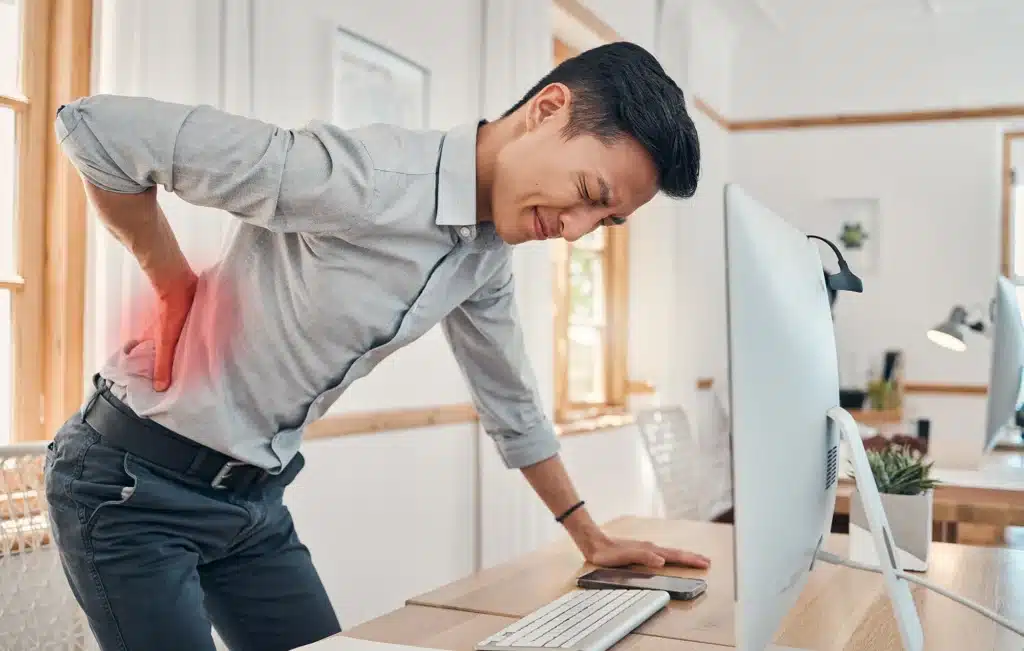
Businessman with back pain at his desk

What Are the Possible Causes of Lumbar Radiculopathy?

A range of conditions can place pressure on a nerve root in the lower back. Some are related to age-related changes in the spine, while others are less common. Understanding the underlying cause helps guide appropriate assessment and treatment.

Ruptured or herniated spinal disc

One of the most common causes is a herniated (slipped) disc. A spinal disc has a softer centre and a tougher outer layer. If the disc bulges or a fragment protrudes, it can press on a nearby nerve root and trigger inflammation. This is often associated with leg pain that may be worse than the back pain.

Nerve roots leave the spine through openings called foramina. These openings can narrow due to disc height loss, joint enlargement, or bone spurs, resulting in nerve compression.
Central canal narrowing can compress nerve structures, particularly in older adults. Symptoms may include leg pain, tingling, heaviness, or reduced walking tolerance, sometimes improving with sitting or leaning forward.
Spondylolisthesis occurs when one vertebra shifts forward relative to another. It can reduce space for the nerve root and lead to nerve irritation, especially with standing or walking.
Infections or tumours affecting the spine are uncommon causes, but they can irritate or compress nerve structures and require prompt medical assessment when suspected.

Symptoms of Lumbar Radiculopathy

Lumbar radiculopathy can develop suddenly or gradually, and symptoms may fluctuate.

The primary symptom is radiating leg pain that:

  • Starts in the lower back or buttock and travels down the leg (thigh/calf/foot)
  • Often affects one side, though it can involve both sides
  • May worsen with certain movements or positions (for example, prolonged sitting, bending, or coughing/sneezing/straining in some people)

Changes in sensation are also common. Many people notice tingling, “pins and needles” or numbness that mirrors the pathway of the pain through the shoulder, arm and hand. These sensations may accompany pain or appear on their own. As the condition progresses, muscle weakness may develop in the shoulder, arm or hand.

The following additional symptoms may indicate that there is also cervical myelopathy due to spinal cord compression:

  • Difficulty with fine movements in the hands (loss of dexterity)
  • Numbness in the hands and feet
  • Difficulty coordinating your legs, which can make walking unsteady or even result in falls
  • Loss of bowel or bladder control

Is Leg Pain a Sign of Lumbar Radiculopathy?

Not all leg pain comes from a pinched nerve. However, lumbar radiculopathy is more likely when pain:

  • Radiates in a clear line down the leg
  • Is accompanied by tingling, numbness, or weakness
  • Changes with spine posture or certain movements

Other conditions (such as hip problems, peripheral nerve entrapment, vascular issues, or muscular strain) can mimic similar symptoms, which is why proper assessment matters.

Who Is at Risk of Lumbar Radiculopathy?

Lumbar radiculopathy can affect anyone, but certain factors increase risk.

Age

Degenerative changes in discs and joints become more common with age, increasing the likelihood of narrowing around nerves. Disc herniation can also occur in younger adults, especially after strain or injury.

Activity and Mechanical Factors

Factors that may increase risk include:

  • Repetitive bending, twisting, or heavy lifting
  • Prolonged sitting with poor ergonomics
  • High-impact activities or sudden overexertion
  • Poor core and hip conditioning (reduced spinal support)

Previous Episodes

A history of radicular pain can increase the chance of recurrence, particularly if underlying degenerative changes persist.

How is Lumbar Radiculopathy Diagnosed?

Lumbar radiculopathy is diagnosed through a combination of clinical assessment and, when necessary, imaging or specialised tests. In many cases, a clear diagnosis can be made based on your symptoms and physical examination alone. Additional investigations are usually reserved for persistent, severe, or unclear cases.

Reviewing your medical history

You may be asked to describe:

  • Where the pain travels and whether it is leg-dominant
  • Triggers (posture, movement, coughing/sneezing)
  • Numbness, tingling, or weakness
  • How symptoms affect walking, sleep, and daily activities
  • Past injuries or previous similar episodes

Physical examination

A physical examination typically checks:
  • Strength in key muscle groups of the leg and foot
  • Sensation and reflexes
  • Walking pattern and balance
  • Nerve tension signs (for example, straight leg raise)

Imaging tests

Imaging is not always needed immediately, especially if symptoms are improving. When indicated:
  • MRI can show discs, nerves, and soft tissues clearly and is commonly used
  • X-rays assess alignment and bony changes; they may help identify instability
  • CT may be used in selected cases to assess bony narrowing in greater detail

Nerve tests (selected cases)

Electromyography (EMG) and nerve conduction studies may be considered when symptoms are atypical, long-standing, or when more than one nerve problem is suspected.

Lumbar Radiculopathy Treatment Options in Singapore

Some cases improve with time and conservative care. When treatment is needed, it usually starts with non-surgical options.

Conservative (non-surgical) treatment

This may include:

  • Activity modification and avoiding aggravating movements for a period
  • Guidance to stay active within tolerance (prolonged bed rest is usually not helpful)
  • Anti-inflammatory medication and pain relief (when appropriate)
  • Physiotherapy to improve mobility, core/hip strength, and movement patterns
  • Heat or cold therapy, posture advice, and a structured home programme

Injections (selected cases)

If pain remains significant despite conservative measures, an injection may be considered, such as an epidural steroid injection or a selective nerve root block.
These procedures aim to reduce inflammation around the affected nerve and may provide a window for rehabilitation. Response varies between individuals.

Surgery (selected cases)

Back Surgery may be considered when:

  • There is significant or progressive weakness
  • Symptoms remain persistent and disabling despite appropriate non-operative treatment
  • Imaging findings match the clinical symptoms and examination

Depending on the cause, procedures may include:

  • Microdiscectomy and Decompression — This procedure involves removing the portion of a slipped or bulging disc that is pressing on a nerve. In cases of spinal stenosis, bone or thickened ligament may also be removed to create more space within the spinal canal. The goal is to relieve pressure on the affected nerve while preserving as much normal structure as possible.
  • Spinal Fusion — In selected cases where there is spinal instability, such as certain patterns of spondylolisthesis, two or more vertebrae may be stabilised using screws and rods, often combined with bone grafting. Over time, the treated segment fuses into a single solid unit, reducing abnormal movement that may be contributing to nerve compression or ongoing pain.

The main aims are to relieve nerve pressure, restore function, and reduce the risk of ongoing nerve damage.

Specialist Care for Lumbar Radiculopathy with Dr Colum Nolan

Lumbar radiculopathy can significantly affect comfort, mobility and daily function. Radiating leg pain, numbness or weakness may interfere with work, sleep and routine activities. Because other spinal and non-spinal conditions can cause similar symptoms, a detailed clinical assessment is essential to determine the severity of nerve involvement and identify the underlying cause, guiding appropriate treatment.

At Oxford Spine & Neurosurgery Centre, Dr Colum Nolan and the specialist team provide comprehensive, evidence-based care tailored to each individual. Management plans are developed with attention to symptom severity, functional goals and long-term spinal health, whether that involves structured non-surgical treatment or, in selected cases, surgical intervention. If you are experiencing persistent leg pain, tingling or weakness, arrange a consultation with Dr Nolan for personalised guidance and a clear plan for your next steps towards recovery.

Frequently Asked Questions (FAQs) About Lumbar Radiculopathy

What is lumbar radiculopathy?

Lumbar radiculopathy occurs when a nerve root in the lower back becomes irritated or compressed, causing pain that radiates into the leg. Tingling, numbness or weakness may also occur along the affected nerve pathway.
The most common causes are a herniated disc or age-related narrowing around the nerves (foraminal or spinal canal stenosis). Less commonly, vertebral slip (spondylolisthesis), infection or tumours may be responsible.
Symptoms usually include leg-dominant pain that travels from the buttock down the thigh, calf or foot. Numbness, tingling or weakness may accompany the pain.
Many cases improve with conservative treatment such as physiotherapy, activity modification and appropriate pain management. However, persistent, worsening or severe symptoms should be assessed by a specialist.
Surgery is typically considered when symptoms do not improve with non-surgical treatment, when pain remains significantly limiting, or when there is significant/progressive weakness or other neurological deficit.
Our Spine & Neurosurgeon in Singapore
Dr Colum Nolan
MB, BCh, BAO, LRCPSI, MRCSI, FRCSI (Neurosurgery)

Dr Colum Nolan is a Senior Consultant Neurosurgeon with over 20 years of experience, specialising in minimally invasive spine (keyhole) surgery and other spine procedures. 

A graduate of the Royal College of Surgeons in Ireland, Dr Nolan underwent neurosurgical training in Ireland and Australia, followed by a fellowship in complex spine surgery at Addenbrooke’s Hospital, Cambridge, as well as rotations at the Orthopaedic Spine Unit in Norfolk and Norwich Hospital. 

Dr Colum is committed to delivering compassionate, patient-centred care, combining surgical precision with a genuine dedication to improving his patients’ quality of life.

Get in touch

Make an Enquiry or Request an Appointment

Our friendly team is here to serve you. For urgent enquiries and appointment requests, please call or WhatsApp us directly.

WhatsApp