


Dr Colum Nolan
Senior Consultant Spine & Neurosurgeon
MB, BCh, BAO, LRCPSI, MRCSI, FRCSI (Neurosurgery)
Pain that starts in the buttock and travels down the leg can appear to originate from the muscles or joints around the hip. In some cases, however, the source lies in the lower spine, where irritation of a nerve root can produce pain extending through the buttock and into the leg, even without noticeable lower-back pain.
This pattern is commonly associated with sciatica, although similar discomfort can arise from irritation of the sciatic nerve around the buttock, including in conditions such as piriformis syndrome. Identifying where the nerve is affected, or whether another structure is responsible for the pain, helps determine the underlying cause and the appropriate approach to treatment.
Why Does Buttock Pain Travel Down the Leg?
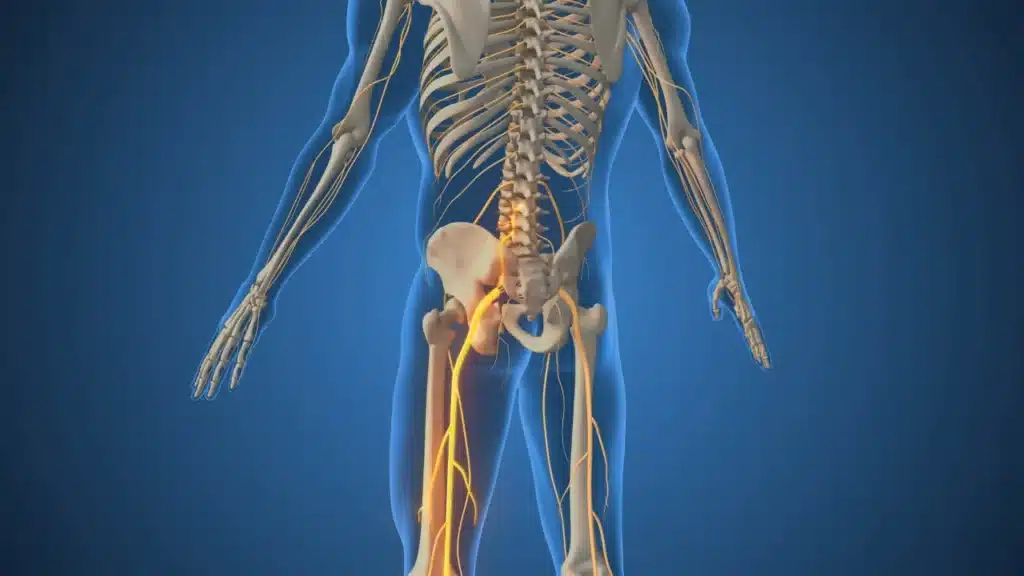
The sciatic nerve is formed by nerve fibres originating from several nerve roots in the lower spine and sacral region. Together, they form a nerve that passes through the buttock and into the leg, carrying sensory information from the lower limb towards the spinal cord.
Irritation of a nerve root or the sciatic nerve can generate abnormal signals that the brain interprets as pain in the areas supplied by the affected nerve fibres. This is why pain can be felt along the back of the thigh or further down the leg, even when the irritation occurs much higher up.
The precise distribution of pain depends on which nerve roots or fibres are involved. Irritation of sensory nerve fibres can also cause tingling, numbness or burning sensations in the affected areas.
What Can Cause Pain to Radiate From the Buttock Into the Leg?
Several conditions can cause buttock pain that travels down the leg. These include problems affecting nerve roots in the lower spine or the sciatic nerve within the buttock. Pain originating from the hip joint or surrounding soft tissues can also spread into the thigh without directly involving the sciatic nerve.
Lumbar Disc Herniation
A lumbar disc herniation occurs when part of an intervertebral disc protrudes beyond its usual position. If the displaced disc material presses against a nearby nerve root, it can trigger pain that radiates from the lower back or buttock into the leg.
Symptoms may worsen with movements that increase irritation of the affected nerve root, particularly bending forward or lifting. Some people also experience numbness or weakness in the affected leg.
Lumbar Spinal Stenosis
Lumbar spinal stenosis refers to narrowing of the spaces around the nerves in the lower spine. This narrowing can place pressure on the nerve roots, particularly when standing or walking.
Pain associated with lumbar spinal stenosis often becomes more noticeable after walking a certain distance and improves with sitting or bending forward. The discomfort may affect one or both legs, depending on which nerves are compressed.
Piriformis Syndrome
The piriformis is a small muscle located deep within the buttock that helps rotate and stabilise the hip. The sciatic nerve normally passes beneath this muscle, although anatomical variations can affect their relationship.
Piriformis syndrome occurs when the sciatic nerve becomes irritated or compressed in the region of the piriformis muscle. Muscle tightness, inflammation or injury may contribute to this irritation, resulting in pain that begins in the buttock and extends down the leg.
Piriformis muscle pain may be felt deep within the buttock, particularly during prolonged sitting or movements involving the hip. When the nearby sciatic nerve is affected, additional symptoms such as tingling or radiating pain can develop.
How Can You Tell Whether the Pain Comes From the Spine or Buttock?
Piriformis syndrome can produce sciatic-type pain, so the distinction lies primarily in where the nerve irritation occurs. Certain symptom patterns may offer clues, although they cannot reliably confirm the cause on their own.
| Feature | Piriformis Syndrome | Sciatica From Spinal Conditions |
| Main area of discomfort | Often centred deep within the buttock | May involve the lower back, buttock or leg |
| Common aggravating factors | Prolonged sitting or movements that place tension on the piriformis muscle | Bending, coughing or sneezing with disc-related irritation; standing or walking with spinal stenosis |
| Lower-back pain | Often absent | May be present, although sciatica can occur without back pain |
| Neurological symptoms | Tingling or numbness may occur, although objective neurological deficits are less typical | Sensory changes or muscle weakness may follow the distribution of an affected nerve root |
Because these symptom patterns overlap, the distinction cannot be made reliably from pain location or aggravating activities alone.
How Is the Cause of Radiating Buttock Pain Identified?
Identifying the cause of radiating buttock pain involves examining how the symptoms developed and whether they suggest irritation of a spinal nerve root, the sciatic nerve or another structure around the hip.
The evaluation may include:
- Medical history: Reviewing when the pain began, how it has progressed and which activities aggravate it. Previous spinal conditions or injuries may also provide relevant context.
- Physical examination: Assessing lower-limb strength, reflexes and sensation to identify signs of nerve involvement. Specific movement tests can help determine whether symptoms are reproduced by tension on the spinal nerves or movements involving the piriformis muscle and hip.
- Imaging and further investigations: An MRI of the lumbar spine may be considered when symptoms persist, neurological deficits are present or a structural problem is suspected. Additional investigations may be needed if the findings do not clearly explain the symptoms.
Imaging findings must be interpreted alongside the clinical examination, as abnormalities seen on a scan do not always explain the pain. Piriformis syndrome is primarily a clinical diagnosis, with investigations sometimes used to exclude other causes of sciatic-type symptoms.
When Should You Seek Medical Attention for Buttock Pain That Travels Down the Leg?
Medical evaluation is advisable when the pain persists despite initial self-care or becomes increasingly disruptive to daily life.
Certain symptoms may also indicate more significant nerve involvement and warrant prompt assessment:
- Persistent numbness or tingling: Sensory changes that continue or become more pronounced, particularly when accompanied by radiating leg pain.
- Leg weakness: New weakness in the affected leg requires urgent medical assessment. Severe or rapidly worsening weakness requires emergency attention.
Seek immediate emergency medical attention if the pain is accompanied by new difficulty passing urine, loss of bladder or bowel control, or numbness around the groin and inner thighs. These symptoms can indicate serious nerve compression, including cauda equina syndrome.
Get to the Bottom of Pain Travelling Down Your Leg With Dr Colum Nolan
Still unsure what’s causing the pain in your buttock and leg? Similar symptoms can make it difficult to know whether you’re dealing with a spinal problem or another source of discomfort. A closer evaluation can help clarify whether nerve compression is involved and what treatment may be appropriate for your condition.
At Oxford Spine & Neurosurgery Centre, Dr Colum Nolan assesses spinal conditions that can cause radiating leg pain, including nerve root compression. Depending on the diagnosis, treatment may involve non-surgical management, with surgery considered for selected cases.
Schedule a consultation to investigate the cause of your pain and discuss the available treatment options.
Frequently Asked Questions (FAQs) About Pain That Travels Down the Leg
Can buttock and leg pain go away on its own?
Some cases of radiating buttock and leg pain improve over time, particularly when associated with temporary nerve irritation. Recovery depends on the underlying cause and severity of symptoms. Pain that persists, repeatedly returns or is accompanied by neurological changes should be evaluated.
Should you rest or stay active when experiencing sciatic-type pain?
Prolonged bed rest is generally discouraged for uncomplicated sciatic-type pain. Maintaining comfortable movement and modifying activities that aggravate symptoms may be more helpful. The appropriate level of activity depends on the cause of the pain and whether neurological symptoms are present.
Can stretching make piriformis syndrome worse?
Stretching may aggravate symptoms if it places excessive tension on an irritated sciatic nerve or surrounding tissues. Exercises that reproduce radiating pain should not be forced. The suitability of piriformis stretches depends on whether the muscle is contributing to the symptoms and how the nerve responds to movement.
Meet Our Doctor
Dr Colum Nolan
Senior Consultant Spine & Neurosurgeon
MB, BCh, BAO, LRCPSI, MRCSI, FRCSI (Neurosurgery)
Dr Colum Nolan is a senior consultant spine and neurosurgeon, as well as the Medical Director of Oxford Spine & Neurosurgery Centre. He undertook specialist neurosurgery training in Ireland and Australia, and later on completed a complex spine surgery fellowship at Addenbrooke’s Hospital in Cambridge, UK.
Dr Colum held key leadership roles including Director of the Spine and Spinal Disorders Programme at the National Neuroscience Institute (NNI), as well as the Head of Neurosurgery Service at Sengkang General Hospital.
With his depth of experience, Dr Colum is committed to guiding each patient towards the safest and most effective treatment for their needs.

